Effective 18 November 2026.
Some links on itsdark.io are affiliate links. If you click one and buy the product, the seller pays us a commission. It costs you nothing extra. This page explains where those links appear, how they are marked, and what they are never allowed to influence.
How an affiliate link works
An affiliate link is an ordinary hyperlink with an identifier for itsdark.io attached. When you follow it, the merchant’s site records that the visit came from us, usually with a cookie on its own domain. If you buy within the merchant’s attribution window, we are credited with the sale.
The identifier describes us, not you. We do not learn your name, email address or what else you bought. The merchant reports a sale and a commission amount, and that is all. Any tracking that happens after the click is done by the merchant under its own privacy policy, so read it before you buy.
Where affiliate links appear
Only in articles that discuss a product you could reasonably want to buy, such as a VPN service. Most pages on this site, including every explainer about how Tor and onion routing work, have no commercial links at all, because the software they describe is free.
How we mark them
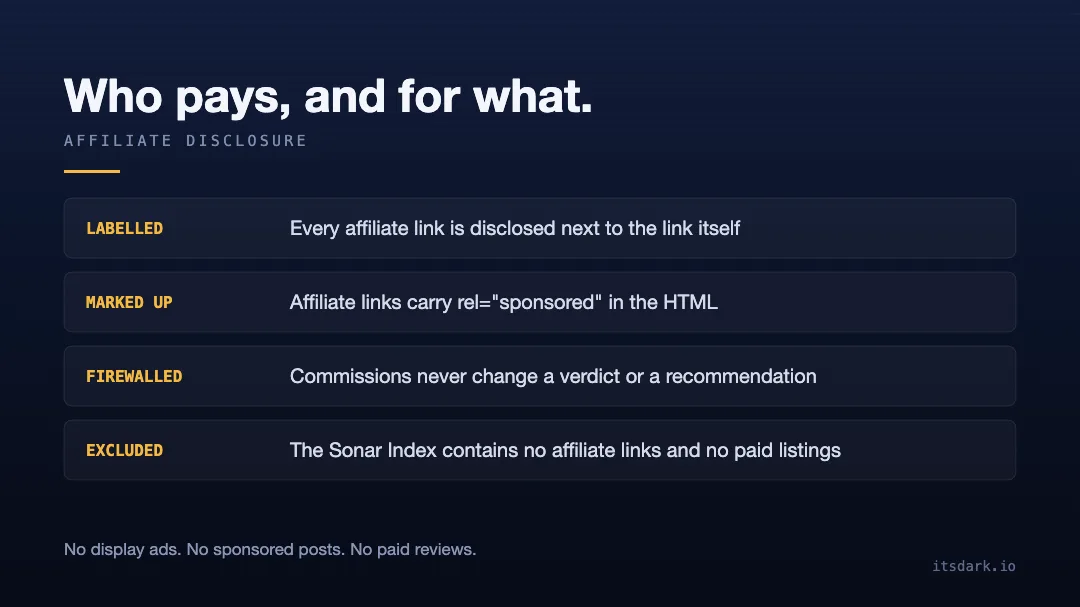
- In the text. Every affiliate link is disclosed next to the link itself, in the same paragraph, in plain words. You do not have to find this page to know a link is commercial.
- In the markup. Affiliate links carry
rel="sponsored", the attribute search engines ask publishers to use for paid links. Hover the link or view the page source and you can confirm it. - In the URL. We do not hide affiliate destinations behind redirect scripts that log your click on our side. The link goes to the merchant.
What commissions can never influence
- Verdicts. We recommend a product only after testing it, and the assessment is written before we look at whether an affiliate programme exists. A product with no programme can still be our recommendation. A product with a generous programme can still get a poor review.
- The “you don’t need this” answer. Where a paid product adds nothing for the reader, we say so. The clearest example on this site: most people using Tor Browser do not need a VPN on top of it, and we tell them that even though VPNs are the main product category that pays commissions in this field.
- The Sonar Index. The directory contains no affiliate links, and no listing has been or will be paid for. Entries qualify under the published rules in How Sonar works and under nothing else.
- Myth Meter and legal coverage. Fact-checks and law explainers are not commercial content.
What we do not accept
No display advertising. No sponsored posts. No paid link insertions. No payment for reviews, and no review units supplied on condition of a positive write-up. If a company offers any of these, the answer is no. This is part of our editorial policy and of the No-Links Pledge.
Why we use affiliate links at all
Servers, the Tor checking infrastructure behind Sonar and the time it takes to keep guides current all cost money. The alternatives were advertising networks, which track readers across the web, or a paywall, which would put safety information out of reach of the people who need it. Clearly labelled affiliate links on a handful of product pages are the least invasive option we found. They involve no third-party script on our pages and no data about you leaving your browser unless you choose to click.
Regulatory note
This disclosure is made in line with the United States Federal Trade Commission’s Endorsement Guides (16 CFR Part 255) and equivalent consumer protection rules in the European Union and the United Kingdom, which require a clear statement when a publisher has a financial relationship with a product it recommends.
Questions
If you find a link you believe is commercial and is not labelled, that is an error and we will fix it. Email [email protected] with the page URL. Related: privacy policy, disclaimer and about itsdark.io.
