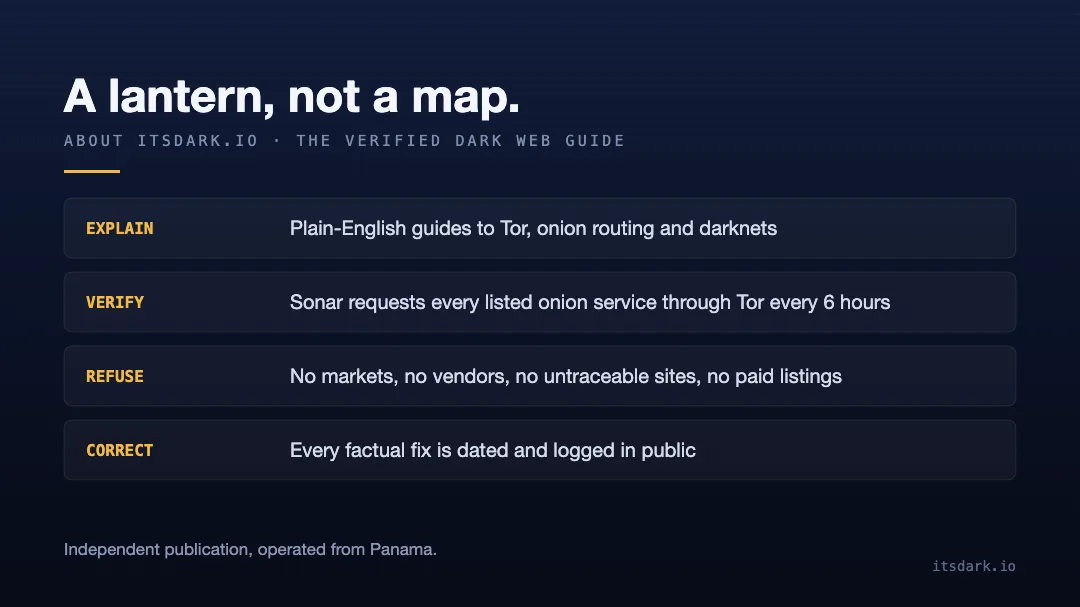
itsdark.io is the verified dark web guide: plain-English explanations of the dark web, the deep web and darknets, plus a directory of legitimate onion services that our own software requests through Tor every 6 hours.
Why this site exists
Search for “dark web links” and you get pages of onion addresses that nobody has opened in years. When we went through the popular lists, most entries were dead. A good share were still version 2 addresses, a format Tor Browser stopped resolving in October 2021. Some pointed at phishing clones of services that had long since moved.
The explanations around those lists were not much better. The same three claims get copied from article to article: that the dark web is 96% of the internet (it isn’t, that figure confuses it with the deep web), that Tor makes you anonymous by default (it gives you network-layer anonymity, which is a narrower thing), and that using it is illegal (in most countries it is not).
We built itsdark.io to do two jobs properly. First, explain how the technology works, at the level of circuits, relays, descriptors and keys, in language a non-engineer can follow. Second, maintain a small index of onion services that we can trace to a real owner and prove are reachable.
What we publish
- Guides. How onion routing builds a three-hop circuit, what changed between v2 and v3 onion addresses, how Tor, I2P and Freenet differ, and where the deep web ends and the dark web starts.
- The Sonar Index. Onion services run by identifiable organisations such as newsrooms, email providers and privacy projects. Each address is read from the owner’s own clearnet site, checksum-validated, and probed over Tor every 6 hours. How Sonar works documents the whole pipeline, including the failure thresholds.
- Safety and law. What Tor protects, what it leaks, and what the law says in practice. We write about risk the way an engineer writes a threat model: who the adversary is, what they can observe, and what a given tool does about it.
- Myth Meter. Fact-checks of common dark web claims, each with the evidence linked.
What we refuse to publish
No markets. No vendors. No forums, mixers or paste sites. No onion address whose owner we cannot identify. No paid listings, ever. The full commitment is in the No-Links Pledge, and it is the reason this site is safe to cite in a classroom or a newsroom.
Who writes here
Articles carry a byline. Mara Fathom writes most of the guides and maintains the technical explainers on Tor internals and onion addressing. Before anything goes live, a second person checks the numbers, dates and named claims against the original source, as set out in our editorial policy.
We would rather be judged on the work than on a biography. Every technical claim on this site links to something you can check yourself: a Tor Project specification, a release note, a court filing or a published paper. If a claim has no source, treat that as a bug and report it.
Who runs the site
itsdark.io is an independent publication operated from Panama by a small team. It has no parent company, no outside investors and no advertising contracts. It is not affiliated with the Tor Project, with any organisation listed in the Sonar Index, or with any dark web service.
The site is funded out of pocket, with affiliate commissions on a small number of clearly labelled product links as the only planned revenue. The affiliate disclosure explains exactly how that works and what it can never influence.
How the site itself is built
A guide to privacy tools should not surveil its readers, so the site is deliberately boring under the hood:
- No analytics, no advertising scripts and no third-party fonts or embeds. Every asset loads from itsdark.io.
- No accounts, no comment form and no newsletter. There is nothing to sign up for.
- An onion mirror, for readers who prefer not to expose an IP address at all. The address is in the footer of every page.
The privacy policy lists every piece of data that does exist, down to the access log fields.
Policies and contact
- The No-Links Pledge: what we will never publish
- How Sonar works: how directory entries are verified and checked
- Editorial policy: sources, fact-checking and independence
- Corrections log: every factual fix, dated
- Affiliate disclosure
- Privacy policy, terms of use and disclaimer
- Copyright and takedown requests
Email is the only way in: [email protected]. The contact page explains what to include so your message gets to the right person quickly.
