This policy describes how articles on itsdark.io are sourced, checked, updated and funded. It applies to every guide, every Myth Meter verdict and every entry in the Sonar Index.
Sources
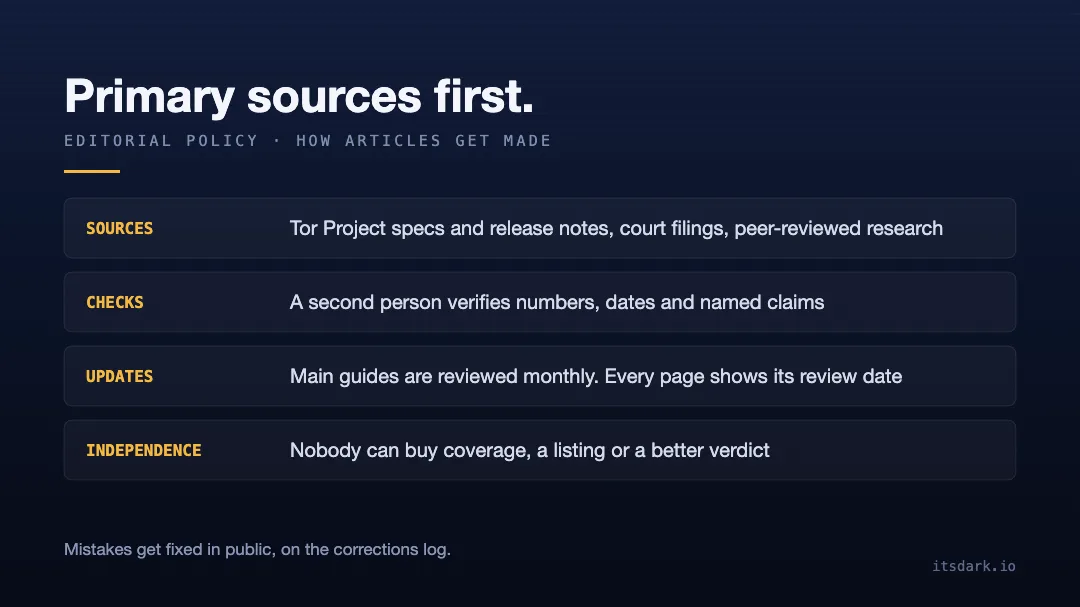
We cite primary sources wherever they exist: Tor Project specifications, proposals and release notes, source code, court filings, government and law-enforcement releases, and peer-reviewed research. For a claim about how Tor behaves, the specification or the code outranks any article about it, including ours.
We use major newsrooms for events, and we say so when a fact rests on a single report. Statistics get the same treatment as code: we trace them to the dataset or paper that produced them, and when a widely repeated number has no traceable origin we say that instead of repeating it.
Articles link only to clearnet sources. The only onion addresses on this site are in the Sonar Index, under the rules in How Sonar works.
Fact-checking
Every article is checked by a second person before publishing. Numbers, dates, version numbers and claims about named organisations are compared against the original source, not against a summary of it. Myth Meter verdicts always link to the evidence behind them, so you can disagree with the verdict using the same material we used.
Technical explanations are checked against current behaviour. Tor changes: address formats are retired, defaults move, features are removed. A guide that was accurate two releases ago can be wrong today, which is why review dates matter.
Updates and review dates
Each article shows the date it was last reviewed. We review our main guides every month, and sooner when a Tor Browser release or a legal change affects them. A review that changes nothing still updates the date, because “checked and still correct” is information.
Corrections
When we get a fact wrong, we fix the article and list the change, with its date, on the corrections log. Small wording and formatting edits are not logged. We do not silently rewrite a claim that turned out to be false. To report an error, email [email protected] with the tag [correction].
What we will not publish
See the No-Links Pledge. In short: no markets, vendors or untraceable sites, no instructions for illegal activity, and no paid listings. Closed criminal cases appear only as history, sourced from court records and mainstream reporting.
Language and tone
We write for readers who are curious, not for readers who are already engineers. Jargon is defined the first time it appears, and the glossary covers the rest. We do not use fear to hold attention. If a risk is small, we say it is small; if a tool does not protect against something, we say that as well.
Use of automated tools
The Sonar Index is maintained by software: it reads addresses from owners’ websites, validates v3 checksums and runs reachability checks. Its rules are published and its output is reviewed by an editor when anything unusual happens. Articles are written and edited by people, who are responsible for every claim in them regardless of what tools were used for research, drafting or proofreading.
Affiliate links
Some articles link to products, such as VPNs, that pay us a commission if you buy. We only recommend products we have tested, we disclose every affiliate link next to it, and commissions never affect our verdicts. Where a product adds nothing for a reader (for example, a VPN for many Tor users), we say so. Details are in the affiliate disclosure.
Independence
No company, advertiser or listed organisation can pay for coverage, a listing or a better verdict. We do not accept sponsored posts, paid link placements or review copies with conditions attached. itsdark.io is not affiliated with the Tor Project or with any service in the Sonar Index.
Who is responsible
The editorial desk of itsdark.io is responsible for this policy and for everything published under it. The site is operated from Panama. Questions and complaints about our journalism go to [email protected], and every one gets read. More about the project is on the about page.
